YYLO: Bounded AI Coding Orchestration + Git Memory
YYLO coordinates AI coding agents with bounded loops and Git-native task records. Keep durable evidence, guarded merges, and reviewable progress.
✦Key takeaways
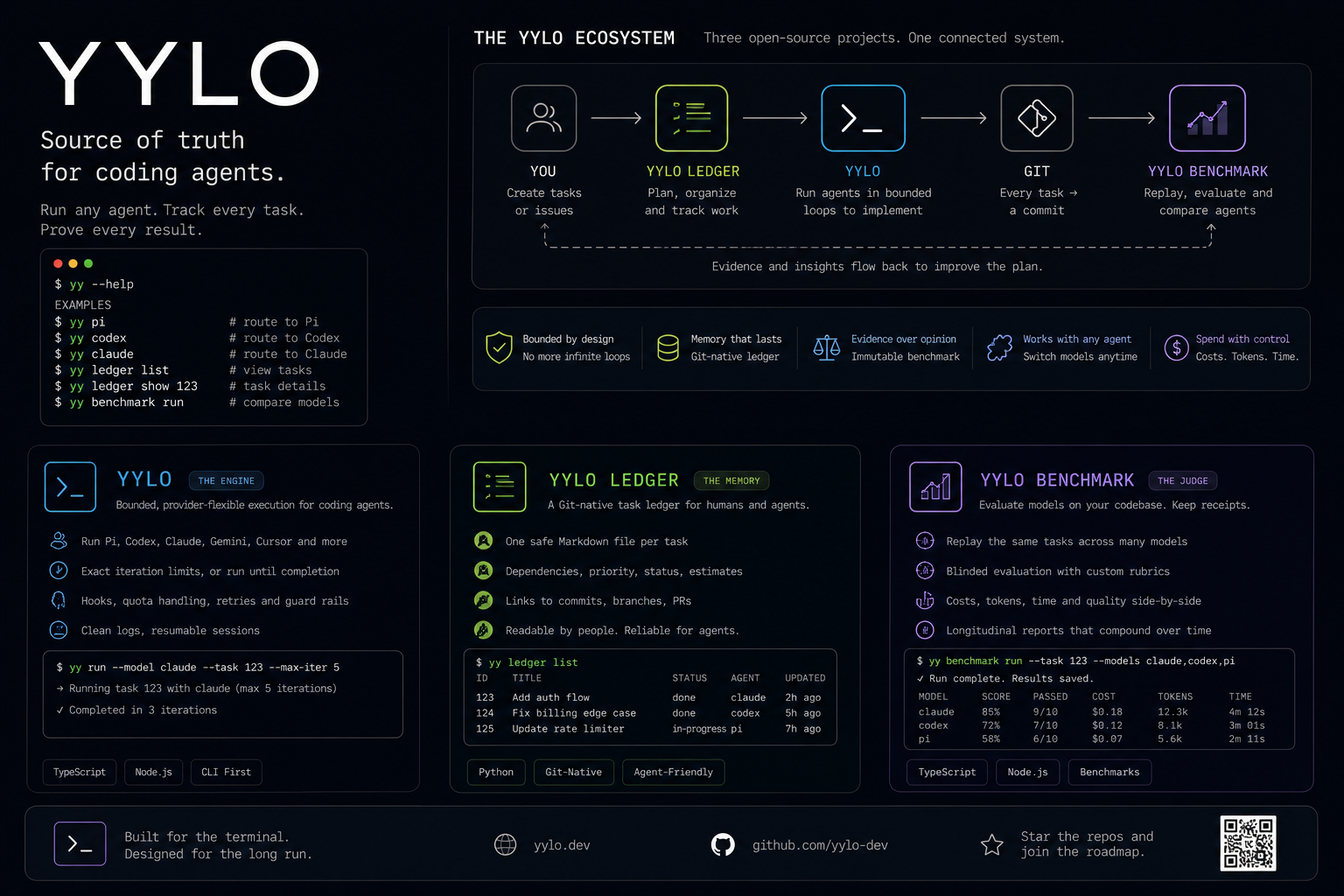
- 1YYLO splits responsibilities: YYLO Ledger preserves task intent and evidence; YYLO CLI orchestrates agent execution and guarded Git delivery.
- 2Bounded loops and iteration limits replace unbounded agent runs, reducing “mystery changes” and runaway behavior.
- 3Git worktrees isolate agent work so merges stay guarded and inspectable.
- 4Ledger keeps canonical task state in reviewable repository files, plus an opt-in hash-chained history for durable progress records.
- 5Validation evidence receipts (tests and policy-bound review artifacts) make acceptance decisions auditable and repeatable.
Why I built YYLO for evidence-first coding
I built YYLO because agentic coding tends to fail where engineering teams care most: traceability, reviewability, and repeatability. When an AI agent runs without constraints, it’s hard to answer basic questions—what was the bounded outcome, what changed, which attempt passed validation, and why that acceptance decision was made.
YYLO is split into two open-source tools so responsibilities are clear. YYLO Ledger is a Git-native task and Record store that keeps canonical task state in repository files and preserves an opt-in hash-chained history over time. YYLO CLI is a TypeScript orchestrator that runs coding agents while replacing unbounded loops with iteration limits, session continuity, observable commands, and validation evidence.
The goal is practical: coordinate coding agents from engineering intent through validated code while preserving the task, session, review, and evaluation evidence that explains what happened. I wanted something that doesn’t replace Git or your repository workflow—it coordinates execution and makes the work inspectable.
In other words, YYLO treats “memory” as engineering memory. It links intent, decisions, attempts, validated code, and (eventually) real-world outcomes. That’s why the system is designed to keep evidence receipts, commit-linked completion, and integrity checks as first-class artifacts.
YYLO also fits teams that don’t want a single monolith. You can use Ledger or CLI independently, or combine them for Ralph-style loops with guardrails: bounded iterations, dependency-aware tasks, and auditable software delivery. The modular workflow is meant to be adopted incrementally in existing repos.
The challenges YYLO targets in agent coding
Most agent workflows fail at the handoff between “AI produced code” and “engineering accepted code.” Even if the agent outputs a patch, you still need durable answers to: What was the intended bounded outcome? Which constraints and dependencies were applied? Which validation steps were run? And what evidence supports acceptance?
Unbounded agent loops create another failure mode: the agent keeps trying until it feels done, not until it meets a defined acceptance policy. That makes it difficult to compare attempts, reason about regressions, and keep review sessions grounded in the same criteria every time.
Finally, many agent systems don’t respect Git as the source of truth for change. If the agent edits files in-place without isolation, it becomes harder to separate “agent work-in-progress” from “reviewable change.” Without isolation and guarded delivery, merges can become less deterministic and less explainable.
YYLO is designed around these pain points: it coordinates agent execution while preserving provenance, it validates results with evidence receipts, and it records what happened so future work can reuse the same intent and acceptance logic rather than re-deriving it from scratch.
What YYLO does with bounded loops and evidence
YYLO coordinates coding agents from engineering intent through validated code while preserving the task, session, review, and evaluation evidence that explains what happened. It does this by separating task truth from execution orchestration.
YYLO Ledger focuses on task and Record management in a Git-native way. Canonical task state stays in reviewable repository files so your team can review intent, blockers, and responses like any other change. Opt-in hash-chained history preserves progress over time, while a disposable SQLite cache speeds up queries without becoming the source of truth.
YYLO CLI focuses on execution control. It routes work to an agent, preserves the agent’s worktree and session provenance, and replaces unbounded agent loops with iteration limits. It supports reusable command or YAML workflows, observable commands, and validation evidence. In configured repositories, it can isolate work in exact-base Git worktrees and protect integration with guarded merge operations.
Together, the system creates a durable chain from: (1) intent, (2) bounded agent attempts, (3) validation evidence receipts, (4) recorded outcomes tied to commits, and (5) merge outcomes that are reviewable and auditable. That’s the core idea: controlled orchestration plus engineering memory.
- ✓Bounded agent execution via iteration limits
- ✓Git-native Ledger for canonical task state in repo files
- ✓Validation evidence receipts and policy-bound review artifacts
- ✓Isolated execution in exact-base Git worktrees
- ✓Guarded merge operations for controlled integration
- ✓Session continuity and provenance tracking for agent attempts
- ✓Opt-in hash-chained history for durable progress records
- ✓Typed Records, integrity checks, and commit-linked completion
- ✓Disposable SQLite cache for fast queries without source-of-truth risk
- ✓Reusable command and YAML workflows for repeatable runs
Getting started with YYLO in your repo
Define a bounded task intent
Create a task record that describes the bounded outcome, its constraints, and dependencies. In practice, you start from an intent like “Add keyboard navigation” and express what “done” means for your engineering team.
Run YYLO CLI to delegate execution
Use YYLO CLI as the orchestrator. It routes the bounded work to a configured agent (Claude Code, OpenAI Codex, Gemini, or Pi), preserves the agent’s worktree/session provenance, and enforces iteration limits so the loop ends based on bounds and validation—not vibes.
Validate with evidence receipts
After the agent produces a candidate change, YYLO collects validation outputs—tests and evidence receipts—and supports policy-bound review. The point is that acceptance becomes inspectable: you can trace what was tried and what evidence supports the final decision.
Record what happened in YYLO Ledger
Ledger stores task responses, commits, review evidence, and merge outcomes as durable Records. Canonical task state remains in reviewable repo files, while optional hash-chained history preserves the timeline of progress over time.
Merge with guarded delivery
When validation and review criteria are satisfied, YYLO can deliver the change through guarded merge operations. If configured, it uses isolated worktrees tied to exact-base commits so the integration step is controlled and explainable.
Who benefits most from YYLO
Solo founders building with agents
You want agent speed without losing control. YYLO helps you keep bounded loops, durable task records, and evidence receipts so you can ship with fewer “what just happened?” moments.
Small engineering teams with code review
Your bottleneck is review quality and traceability. Ledger’s Git-native task state and commit-linked completion make it easier to review intent, blockers, and validation evidence alongside code changes.
AI platform or tooling owners
You need an orchestrator you can audit and reason about. YYLO’s separation of orchestration (YYLO CLI) and task memory (YYLO Ledger) supports controlled experimentation across multiple models.
Teams running multi-model debugging
You want to compare agent attempts and keep evidence for each run. YYLO Ledger and bounded execution make attempt histories and validation outcomes durable and queryable.
YYLO vs Claude Code, Codex & agent loops
YYLO is not just a chat wrapper. It adds bounded orchestration, Git-native task records, and validation evidence receipts. Here’s how that design compares to more agent-like “run loops” and general agent tooling approaches.
| Feature | YYLO | LangChain | OpenAI | GitHub |
|---|---|---|---|---|
| Bounded agent loop control | Iteration limits replace unbounded loops; execution ends based on bounds and validation. | Often supports agent loops, but boundedness is typically configured per integration rather than a first-class, evidence-first workflow. | Model/agent behavior varies; orchestration bounds depend on the surrounding framework. | GitHub itself doesn’t orchestrate agent loops; bounds are handled by external tooling. |
| Durable task memory in Git | Ledger keeps canonical task state in reviewable repository files; optional hash-chained history preserves progress over time. | Can store state externally; Git-native canonical task truth is not the default pattern. | Provides APIs for agents; durable Git-native task records depend on your implementation. | GitHub provides repo storage but not a purpose-built task/Record store with integrity checks. |
| Validation evidence receipts | Tests, evidence receipts, and policy-bound review artifacts are recorded and tied to commit-linked completion. | Validation exists, but evidence receipts and commit-linked completion patterns are typically custom. | Validation depends on your application logic; evidence artifacts aren’t automatically structured as Ledger Records. | GitHub checks exist, but there’s no built-in evidence receipt model tied to agent attempts. |
| Guarded Git delivery | Can isolate work in exact-base Git worktrees and protect integration with guarded merge operations. | Worktree isolation and guarded delivery are usually implemented by the developer. | Depends on your orchestration and repo workflow; guarded merges aren’t provided as an agent-evidence feature. | GitHub merges are governed by branch protection, but it doesn’t provide agent worktree isolation as a workflow primitive. |
Real-world use cases
Solo founder triaging feature work with evidence
I define a bounded task intent (what “Add keyboard navigation” must include) and run YYLO CLI so the agent iterates within limits. YYLO records the validation evidence receipts and commit-linked completion in YYLO Ledger, so I can review acceptance decisions and reuse the same intent next time.
Team shipping with guarded merges and isolated worktrees
In a configured repository, YYLO CLI executes agent work in isolated worktrees and only delivers changes through guarded merge operations after validation receipts exist. Ledger keeps the canonical task state in reviewable files, so reviewers can see blockers, constraints, and evidence without digging through chat logs.
Multi-model debugging across Claude Code, Codex, Gemini & Pi
When an agent attempt fails validation, I can compare attempts while keeping provenance and evidence receipts. YYLO’s session continuity and observable commands make it easier to understand what each model tried, what tests were run, and what evidence supports the final selection.
Repeatable test-and-fix cycles for bug tickets
I record dependencies and ready-work discovery in Ledger, then run YYLO CLI to delegate bounded work. Validation evidence receipts and integrity checks keep the cycle auditable: each attempt is recorded, and completion is tied to commits so future work can build on what already passed.
Frequently asked questions
Try YYLO
YYLO — YYLO splits responsibilities: YYLO Ledger preserves task intent and evidence; YYLO CLI orchestrates agent execution and guarded Git delivery.
More from the blog
All articles
dataHabibi: Dubai Housing Forecasts With DLD Data
dataHabibi delivers building-level forecasts for Dubai housing—prices, rental yields, and DLD transactions—refreshed daily, plus Ask AI search.

VideoPopy 3D breakout videos: AI for Frame-Breaking Clips
VideoPopy 3D breakout videos turn prompts or product ideas into AI 3D breakout clips for Reels, Shorts, Instagram, LinkedIn and Facebook. Start with 10 free credits.