BatchData: Property Data APIs & AI Agent Access
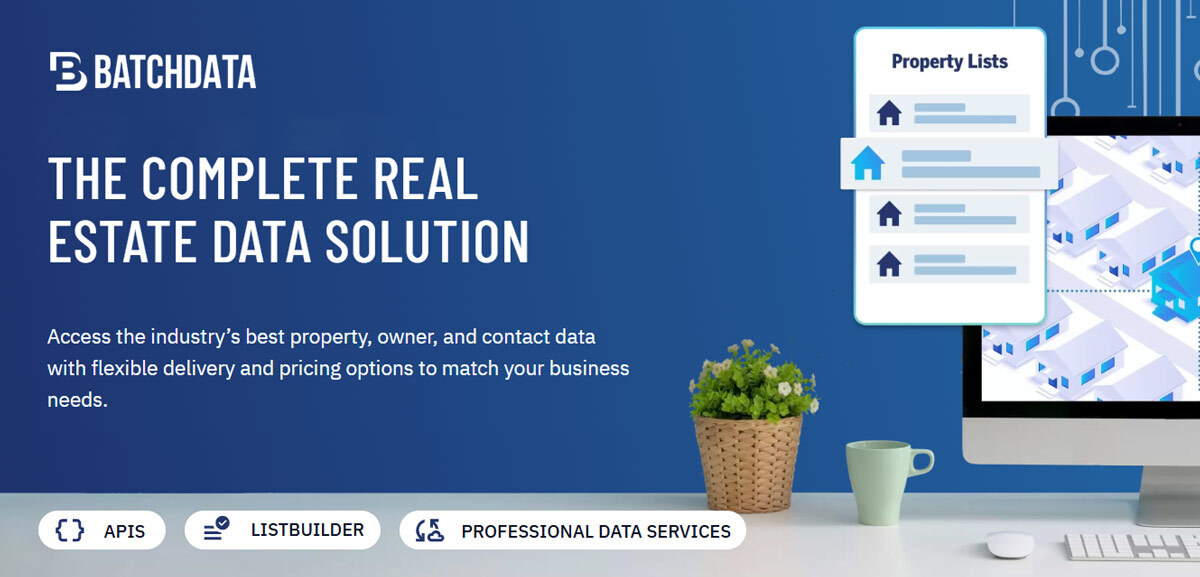
BatchData provides property data, APIs, bulk delivery, and an MCP server for AI agents. Covering 169M+ U.S. parcels, it supports search, permits, skip tracing, and enrichment.
✦Key takeaways
- 1BatchData focuses on property data coverage at scale (169M+ U.S. parcels) plus developer access via API and bulk delivery.
- 2You can use BatchData directly in applications (property search, permits, transactions, ownership) or via an MCP server for AI agents.
- 3The platform is organized around real estate workflows: lead generation, skip tracing, enrichment, valuation, and underwriting research.
- 4Pricing is presented as simple and transparent, with multiple listed price points (e.g., $298 and $386).
- 5If you’re integrating property data into production systems, BatchData’s “API, file or AI agent” approach can reduce glue code.
The Story Behind BatchData
I built BatchData with one goal: make large-scale property data usable by software teams without turning integration into a multi-month project. The platform is designed around the reality that property intelligence doesn’t live in one dataset—teams need address and geocode linking, boundaries, transactions, deeds, permits, valuation-style signals, and ongoing monitoring.
BatchData’s scope is explicit: it covers 169 million+ U.S. parcels, so the product is built for breadth first. That coverage matters because most real estate workflows break when your data source only “mostly” matches the addresses you’re working with.
Instead of forcing every use case into a single interface, BatchData provides multiple access paths: API, file/bulk delivery, and an MCP server for AI agents. That choice reflects how teams actually build—sometimes you need a deterministic API call inside a service, and sometimes you need an agent to query the same underlying property records.
The product’s internal structure mirrors common operational needs. You’ll see dedicated categories for property search, permit data, transactions and mortgage history, people/contact enrichment, skip tracing and reverse skip tracing, and saved search alerts for monitoring changes over time.
Ivo Draginov designed BatchData to support both data work and application work: property data and an API platform that can be used by developers, plus supporting resources like API documentation and a data dictionary so teams can map fields to their systems faster.
The result is a platform that tries to reduce friction between “we have property data” and “our product can use property data.”
The Problem BatchData Solves
Property data is notoriously difficult to operationalize. Teams don’t just need a one-off lookup; they need consistent property identifiers, address-to-geocode resolution, parcel boundaries, and the ability to connect property records to downstream workflows like lead generation, underwriting, or valuation research.
Most teams also run into dataset fragmentation. A single address might require permit history, transaction and deed/sales history, mortgage and pre-foreclosure context, and ownership research. When these pieces come from different sources, integration becomes brittle and expensive to maintain.
Another common problem is that property data is often delivered in formats that don’t match production engineering. If your app is API-first, you need predictable request/response patterns. If your team runs batch jobs, you need bulk delivery. If you’re experimenting with AI agents, you need an interface that can safely query data without custom glue for every agent prompt.
Skip tracing adds additional constraints: you need enrichment and verification workflows that can be executed at scale, plus reverse skip tracing and phone/DNC-aware enrichment. When the data layer can’t support these workflows, teams either underperform or build heavy custom pipelines.
Finally, teams struggle with “coverage vs. usability.” They may find a data vendor that has useful fields, but coverage gaps across U.S. parcels create failure modes that are hard to debug. BatchData’s positioning around 169 million+ U.S. parcels targets this failure class directly.
What BatchData Does
BatchData provides property data and API access for U.S. real estate workflows, plus an AI-agent interface for querying property data. It’s built to support property search, skip tracing, building permits data, enrichment, and decision-support use cases like valuation-style research and underwriting.
At the data layer, BatchData organizes information by the tasks teams perform: property search and address/geocode linking; parcel boundaries; transactions, deed & sales history; pre-foreclosure; listing data; mortgage & transactions; and property intelligence such as comparables-oriented outputs.
For operational workflows, BatchData includes skip tracing and reverse skip tracing, along with people/contact enrichment and verification-style capabilities like phone verification and address verification. That matters because real estate teams often need to clean and enrich records before outreach or underwriting.
BatchData also supports building permits data and saved search alerts, which aligns with how teams monitor changes—new permits, ownership shifts, or other property events—without manually re-checking addresses.
From an integration perspective, BatchData is available as an API, via file/bulk delivery, and through an MCP server so AI agents can query property data. That gives you multiple ways to embed the same underlying dataset into different system architectures.
If you’re comparing vendors, the simplest way to think about BatchData is: it’s a unified property data platform with developer-oriented delivery modes, designed for scale and for real-world workflows rather than isolated lookups.
- ✓Property search API for address and parcel lookups
- ✓Skip tracing and reverse skip tracing workflows
- ✓Building permits data for construction and compliance contexts
- ✓Parcel boundaries and property identifiers for downstream mapping
- ✓People/contact enrichment, including phone and address verification
- ✓Saved search alerts for monitoring changes over time
- ✓MCP server so AI agents can query property data
- ✓Bulk/file delivery for batch jobs and data pipelines
Getting Started with BatchData
Pick the workflow and data slice
Start by mapping your use case to the dataset categories you need—e.g., property search for address-to-parcel resolution, building permits for construction events, transactions/deed history for ownership context, or people enrichment for skip tracing.
Choose your integration mode
Use the API for request/response in your application, request bulk/file delivery for scheduled pipelines, or use the MCP server when an AI agent needs to query property data during reasoning.
Connect and query
Integrate BatchData into your service layer. For API usage, call the relevant endpoints for property search and the specific property intelligence fields your product needs. For agent workflows, expose the MCP server so the agent can run structured queries.
Normalize fields in your system
Use the BatchData data dictionary and API documentation to map returned fields into your internal schema—especially for identifiers, geocodes, and any people/contact attributes you store.
Implement monitoring and refresh
If your workflow depends on changes (like permits or ongoing property status), add saved search alerts or periodic refresh jobs so your database stays aligned with current property data.
Who BatchData is For
Real estate data engineers
You build pipelines that need dependable parcel-level data, boundaries, and property event history. BatchData’s API and bulk delivery modes fit both streaming and batch architectures.
PropTech founders shipping property workflows
You want to launch features like property search, buyer matching, or underwriting research without stitching together multiple vendors. The unified platform and developer delivery options reduce integration overhead.
Skip tracing and lead generation teams
You need enrichment and verification workflows at scale—address verification, phone verification, and reverse skip tracing—so outreach and qualification stay accurate.
AI product builders using agents
You’re building agentic tools that must query real property data safely and consistently. The MCP server lets agents retrieve property information without hardcoding every prompt-to-API path.
BatchData vs Alternatives
If you’re choosing a property data platform, you’ll usually compare API-first providers and general-purpose data platforms. Here’s how BatchData’s “API, file or AI agent” approach stacks up against common alternatives.
| Feature | BatchData | Zillow Research | CoreLogic | Regrid |
|---|---|---|---|---|
| Coverage focus on parcels | 169 million+ U.S. parcels | Market research and aggregated insights; parcel-level coverage varies by product | Enterprise property data coverage varies by contract/product | Parcel data and mapping tools; coverage depends on data layer |
| Primary access modes | API, file/bulk delivery, and MCP server for AI agents | Primarily research/insights; not an MCP-style agent interface | Enterprise datasets and services; access depends on offerings | Mapping and data services; API availability depends on product |
| Property search capabilities | Property search and address/geocode workflows | Research datasets and reporting; specific search APIs vary | Property records access via enterprise services | Geospatial/parcel-oriented data services and APIs |
| Skip tracing and enrichment | Skip tracing, reverse skip tracing, and people/contact enrichment | Not positioned as a skip-tracing/enrichment API | Enterprise property data; skip tracing may be available via specific services | Enrichment depends on geospatial layers and integrations |
| Building permits data | Building permits data available as part of property data resources | Permits data may be available indirectly in research datasets | Permits/assessments may be included depending on contract | Permits support depends on data source layers |
Real-world use cases
PropTech founder building property search
You’re launching a web app where users enter an address and immediately see parcel-level context. BatchData’s property search plus address/geocode workflows let you power UI results and store normalized identifiers for future refreshes.
Skip tracing workflow for real estate leads
You have partial records (addresses or names) and need to enrich them for outreach. BatchData’s skip tracing and reverse skip tracing capabilities can help you verify phone/address details and improve match rates before contact attempts.
Underwriting research for lenders
You want to assemble property context—transactions, deed/sales history, mortgage and pre-foreclosure signals—into a single underwriting view. BatchData’s unified property intelligence categories can reduce the number of separate data sources your team manages.
AI agent that answers property questions
You’re building an agent that must answer questions like “What permits exist for this address?” or “What’s the parcel history?” The BatchData MCP server enables structured property queries from the agent without bespoke integrations per prompt.
Portfolio monitoring for changes
You manage a portfolio and need to detect changes over time. BatchData’s saved search alerts and monitoring-oriented workflows help you refresh records when property-relevant events occur.
Frequently asked questions
Try BatchData
BatchData — BatchData focuses on property data coverage at scale (169M+ U.
More from the blog
All articles
OneKDP: AI Book & KDP Cover Generator
OneKDP helps you create editable interiors and full print-wrap KDP covers, then preview them together before export. Use free KDP tools and AI credits with cost shown before generation.
TapMap: Shared Maps, Local Events & Friends
TapMap is a social network built on maps for restaurants, beaches, events, and friends. Create shared collections, personalize styles, and find what to choose now—free on iPhone, Android, and web.